G7 Heads Push African Infrastructure as Global Asset
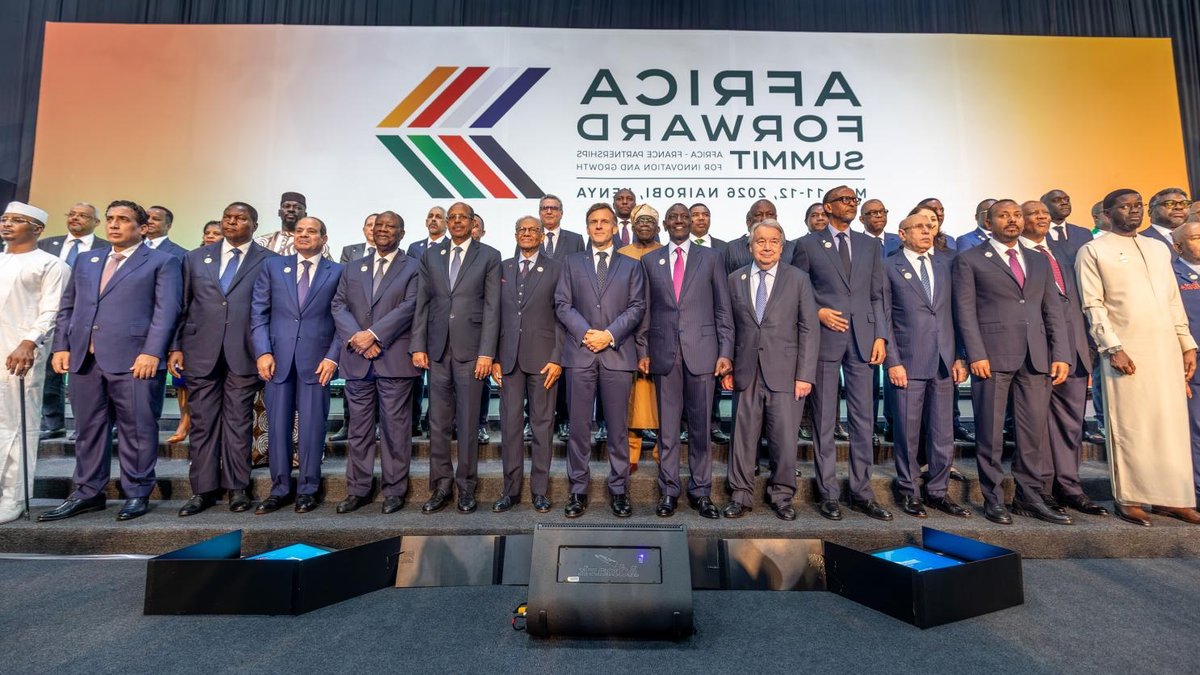
The G7 Africa Forward Heads of State Summit in Nairobi established Sovereign Infrastructure (SI) as a distinct global investment category. This new classification integrates national development initiatives into institutional portfolios as economies advance into the AI-Industrial Era, a period characterized by the convergence of artificial intelligence, energy systems, and industrial supply chains. The summit, led by Kenyan President William Ruto and French President Emmanuel Macron, assembled over 30 African heads of state, sovereign wealth funds, and global financial authorities.
Their discussions centered on transforming infrastructure—covering energy, critical minerals, logistics, and compute systems—into standardized, investable assets. Traditionally, sovereign infrastructure projects operated as isolated initiatives rather than cohesive investment vehicles. This separation has excluded them from the $300 trillion already managed by global institutional investors. Officials at the summit emphasized that the issue lies not in capital availability but in the lack of frameworks satisfying institutional requirements. These include benchmark compatibility, governance standards, and execution certainty.
The Sustainable Markets Initiative (SMI), Africa investor (Ai), and the Institute of Sovereign Investors (ISI) unveiled a new SI architecture. This model was developed through collaboration with sovereign entities and asset owners, focusing on contracted long-duration cashflows, ratings visibility, and program-scale standardisation and replication. The goal is to align sovereign infrastructure with how institutional investors allocate capital, not through one-off projects, but as structured asset classes. A core advancement is the Institutional Investor, Public Partnership (IIPP) framework.
It standardizes contracts, guarantees bankable offtake agreements, and clarifies risk parameters. Dr. Hubert Danso, CEO of Africa investor Group, described this shift as moving from “developmental investment” to “investable development.” The framework reduces perceived sovereign risk while lowering capital costs for governments. The urgency of SI grows as artificial intelligence, energy systems, and industrial supply chains intersect. Africa alone requires $3, 7 trillion in infrastructure to achieve net-zero goals and industrialization.
By treating sovereign assets, such as energy grids, mineral processing facilities, or data centers, as scalable platforms, governments can attract institutional capital while strengthening national competitiveness in what the summit termed green industrial competitiveness. However, institutional investors require execution certainty. Contracts must be enforceable, risks must be clearly defined, and returns must be predictable. The IIPP framework addresses these needs by embedding bankable offtake structures into sovereign projects, ensuring steady revenue streams for investors.
Without such protections, even the most promising infrastructure remains inaccessible to pension funds, sovereign wealth managers, and other long-term investors. Africa’s infrastructure deficit is often described as a funding shortfall, but the core challenge is structural. The summit’s focus on SI reflects a broader realignment of development and finance, breaking down historical silos. The discussion highlighted whether these frameworks can expand rapidly enough to meet the growing demand for institutional-scale exposure. The Institute of Sovereign Investors described the benchmark frameworks as a “critical step” toward wider adoption.
The immediate task is demonstrating that sovereign infrastructure can deliver the consistency and transparency institutional investors demand, without compromising national development objectives. Participants noted that the success of SI depends on three pillars: legal certainty, technical feasibility, and financial sustainability. Legal certainty requires clear contracts that define obligations, dispute resolution processes, and exit strategies. Technical feasibility ensures projects can be executed within budget and timeline.
Financial sustainability guarantees that revenue streams cover debt servicing and operational costs over the long term. The summit’s outcomes will focus on scaling these frameworks to address Africa’s infrastructure needs. The continent’s infrastructure gap costs $46 billion annually in lost GDP, according to the African Development Bank. Closing this divide could unlock $4.3 trillion in economic growth by 2030, according to the African Union. The G7 summit’s push for SI offers a pathway, but only if frameworks can be implemented at scale.

EU's €300bn Global Gateway aims to boost Africa investment


