Croatia Bank Profits Fall 5.5% in Q1
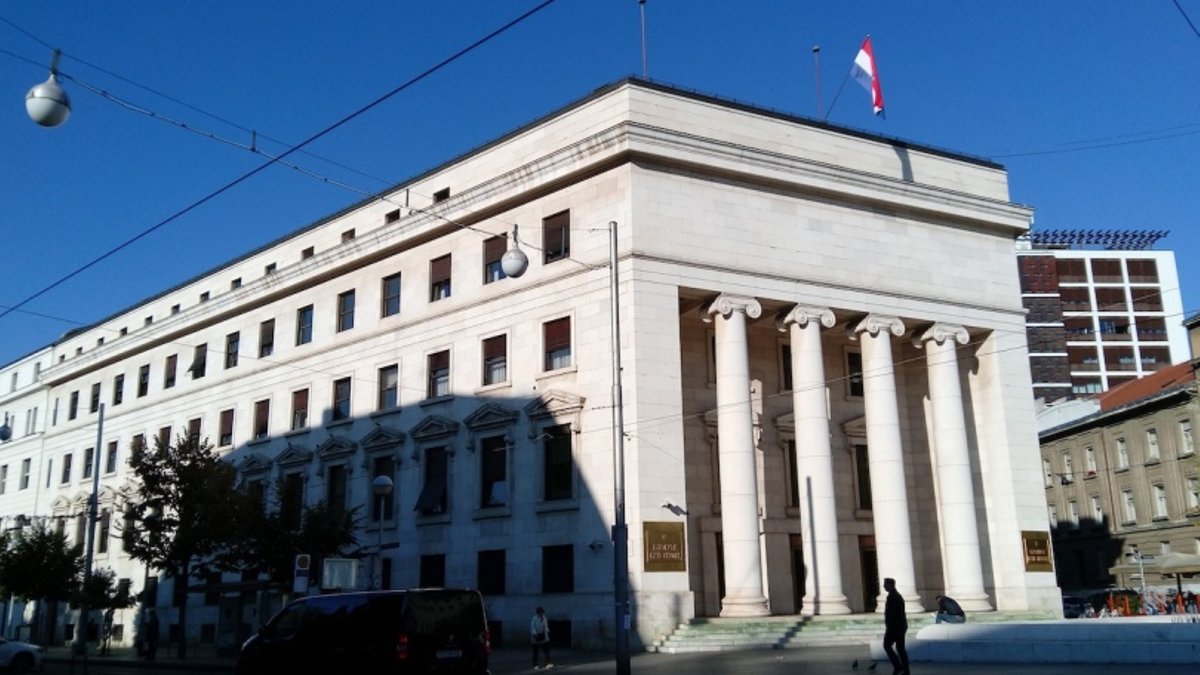
Croatia’s bank profits fell 5.5% year on year in the first half of 2026, a sharp reversal from the sector’s strong start to the year. The Croatian National Bank (HNB) reported the decline in its commentary on banking system developments, published on August 31. Return on equity dropped to 15.3% by the end of June, down from 17.2% at the close of the first quarter, while return on assets stood at 1.6%.
Credit institutions cleared €419.7 million between January and March, 12% more than a year earlier, according to HNB figures reported by The Dubrovnik Times. Zagrebačka banka (ZABA) earned €135.8 million of that haul, Erste&Steiermärkische Bank €121.7 million, and Privredna banka Zagreb (PBZ) €65.4 million. All but one of the country’s 19 banks and its single housing savings bank were in profit during that period.
The central bank noted that part of the first quarter’s strength was a one-off gain booked by one lender on the sale of ownership stakes, though it did not name the institution. Turning a 12% gain into a 5.5% half-year fall means the three months to June were markedly worse than the preceding three. Return on equity stood at 17.2% at the end of March but fell to 15.3% by June.
Related: Discarded climate models were right, targets wrong
Croatia runs one of the European Union’s most concentrated and foreign-owned banking systems. ZABA, part of Italy’s UniCredit, and PBZ, owned by Intesa Sanpaolo, hold roughly 46% of banking assets between them. Erste&Steiermärkische Bank, the local arm of Austria’s Erste Group, has about 18%, OTP banka Hrvatska around 10%, and Raiffeisenbank Austria some 8%. Agram banka, KentBank, Istarska kreditna banka Umag, Croatia banka, Partner banka and Slatinska banka fill out the tail.
Hrvatska poštanska banka (HPB), 77% state-owned and the one substantial domestically controlled lender, ranks fifth by assets and is the exception to the earnings squeeze rather than a refutation of it. Its after-tax profit came to €36.2 million in the half, up 0.4% y/y, on net interest income of €80.3 million, up 3.6%. Operating income rose 4.2% to €101.2 million while operating costs rose 11% to €58.8 million, and the bank made its debut on international capital markets with a €150 million bond.
Loan quality did not deteriorate alongside the profit drop. The non-performing loan (NPL) ratio held at 2.3%, the same as at the end of 2025, and the stock of bad loans fell 0.4%. Corporate asset quality improved outright, the NPL ratio for non-financial companies dropping to 3.3% from 3.7%, while the household ratio edged down to 3.2%.
The sector’s total capital ratio fell to 22.1% at the end of June from 22.9% at the end of 2025. Every institution stayed well clear of the 8% regulatory minimum. Liquidity is ample and less ample than it was: the average liquidity coverage ratio stood at 196.2%, against a required 100% and against 213% six months earlier.
Related: Teachers Leaving Jobs at Alarming Rate Nationwide
The HNB has been leaning against the cycle for a year. It warned in July that interest rate risk had increased, with systemic risk “moderately raised” on strong private-sector lending and residential property prices that have outpaced incomes. “In the event of a slowdown or reversal of the financial and economic cycle, higher levels of indebtedness increase the sensitivity of households and banks to potential shocks,” the central bank said, flagging the risk of a sharper correction in house prices. Longer-dated fixed-rate lending and holdings of long-term debt securities are the specific exposure. Banks hedge with derivatives but “cannot completely eliminate” the risk, the HNB said, and higher hedging costs have pushed some of them back toward variable-rate loans with an initial fixed period. The countercyclical capital buffer rises to 2% on January 1, 2027.
The economy underneath is still growing faster than the bloc it joined. GDP rose 1.7% y/y in the second quarter, against 1.2% for the EU and 1% for the euro area, and Finance Minister Tomislav Ćorić expects more than 2% for the full year. Prices are the constraint on that consumption. Inflation reached 4.1% in August on the national measure, with energy up 17.4% y/y, though the gap to the euro area narrowed to 0.4 percentage points, the smallest since the start of 2022. The tourism season that funds the deposit base is flatter than the record one before it, arrivals and overnight stays up 1% in the first seven months.
None of this is a stressed banking system. Bad loans are low and falling, and S&P raised Croatia to ‘A’ in March on the strength of the same run.

Vietnam Savings Rates Climb to 9.2%


